
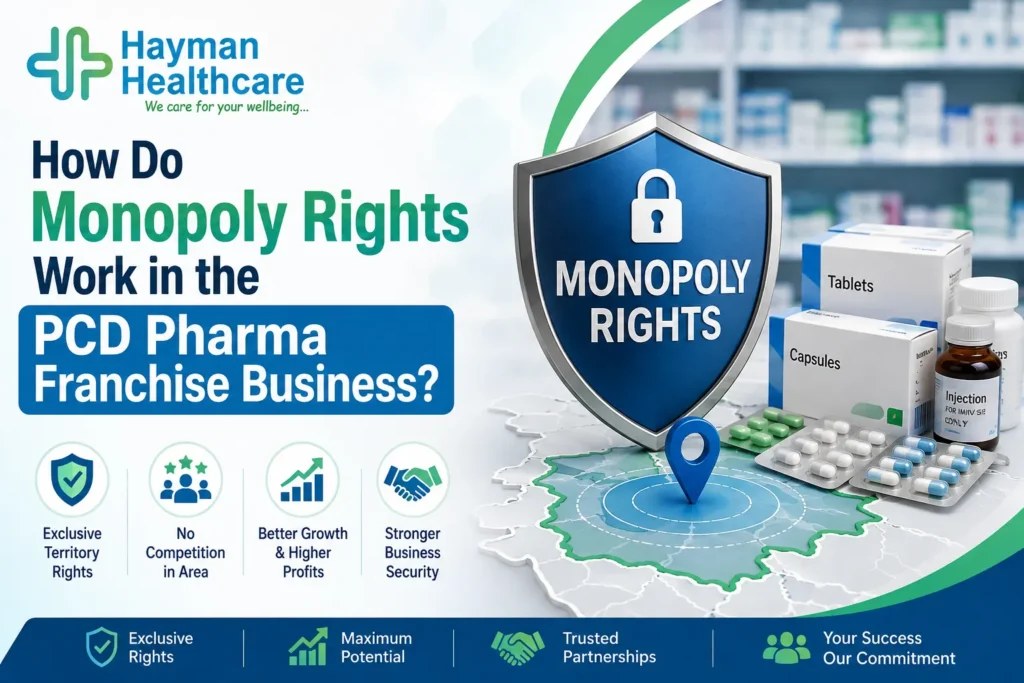
If you have been researching the PCD pharma franchise business, you have probably come across the term “monopoly rights” more than once. It is one of the first things applicants ask about, and for good reason. It directly affects how much competition you will face while building your business. The PCD model lets entrepreneurs and small distributors market and small distribution market and sell pharmaceutical products under a company’s brand name without setting up their own manufacturing unit. One of the most attractive parts of these models is territory-based exclusivity, commonly known as the monopoly rights in PCD pharma franchise agreements.
It is important to understand from the outset that monopoly does not mean you will have no competition at all. Other pharmaceutical companies can still sell their products in your area. What monopoly rights actually protect you from is internal competition. It means the same company does not have to hand your territory over to another franchise partner selling the same products. In this blog, we will break down how these rights work, what benefits they offer, and what you should check before signing a franchise agreement.
What Are Monopoly Rights in a PCD Pharma Franchise?
In simple terms, monopoly rights in pharma franchise agreements mean that a pharmaceutical company assigns a specific geographical territory to one franchise partner for its products. This territory could be a city, a district, a group of areas, or any other zone the company defines. Once this agreement is in place, the company generally does not appoint a second franchise partner to sell the same products in that same territory.
It is worth being clear that these rights are contractual and territory-specific; they are not a legal monopoly over the entire pharmaceutical market in that area. Some agreements go a step further and specify exactly which products or divisions are covered under the exclusivity.
How Do Monopoly Rights Work in the PCD Pharma Franchise Business?
Honestly, the whole pharma franchise deal feels simple once you understand the monopoly rights part in a PCD pharma franchise setup. Most businesses end up with confusion. Here is are simple steps:
Step 1: Territory selection
You have to pick a preferred city, district, or territory you want to run. Then the pharma company checks if that specific area is still free and available.
Step 2: Territory confirmation
After that, the pharma company verifies that the requested territory is open and then states its exact geographical boundaries, so later there is no confusion.
Step 3: Agreement and Rights
Whatever territory gets approved, or the products with wanted to start with. You should get it written into the franchise agreement. This part is important because exclusivity should be in the formal record.
Step 4: Market development
Once everything is documented, you can start promoting and selling, or really distributing, the products of the company inside the assigned territory. You have to focus on relationships with doctors, chemists, hospitals, and other distributors.
Also, monopoly rights in pharma franchise agreements usually link to conditions like minimum purchase requirements, performance benchmarks, and strict adherence to the company’s business policies. In fact, many well-known pharma franchise companies today already define territory, product scope, and these requirements clearly inside the franchise agreement.
What are the Benefits of Monopoly Rights for a Pharma Franchise Partner?
After you have figured out how it works, the next thing is to understand why it matters, like in real day-to-day practice:
Less Internal Competition: You don’t need to compete against another franchise partner from the same company. Inside your protected territory, you can make your own relations and set up a good reputation.
Easy Territory Growth: Because the market is clearly defined, you can focus your actions on strengthening the company’s presence, rather than spreading energy everywhere.
Solid Ties With Doctor and Retailer: With one clear area to serve, it becomes simple to build repeatable, long-running connections with physicians, chemists, hospitals, and distributors.
Chance to Build the Brand Name: Since multiple partners are not promoting the same products in the same area, you can have your own promotion plan to expand your own visibility, not constantly battling for the same doctors and chemists.
Difference Between the Monopoly Rights and Regular PCD Pharma Franchise
Regular PCD Franchise: Territory protection may be less clearly defined; internal competition can depend on the policy of the company, and the territory arrangements can vary from partner to partner.
Monopoly PCD Franchise: The territory is clearly defined, exclusivity against the other franchise partner of the same company is documented, and the products or territory conditions are addressed upfront.
Why Choose Hayman Healthcare for a PCD Pharma Franchise?
At Hayman Healthcare, we have spent over 5 years building a WHO-GMP-certified product portfolio including tablets, capsules, syrups, injectables, cardio-diabetic ranges, and pediatric formulations. We have partnered with franchises across the country. Additionally, we offer territory-based business opportunities, along with the consistent product supply, marketing support, and dedicated assistance to help the partners build their business with confidence. Our focus is to provide transparent communication and a long-term relationship with our partners.
If you are planning to start a PCD pharma franchise, connect with Hayman Healthcare to discuss the territory availability, product selection, and franchise requirements.
Conclusion
Monopoly rights can give a PCD pharma franchise partner exclusive territory protection against the other franchise partners of the same company. The value of this protection depends on how clearly the territory, products, duration, and conditions are documented. The monopoly rights in the PCD pharma franchise agreements support the focused market development, but they do not automatically guarantee the business success on their own. Choosing the right company, right products and right commercial terms are important to run any franchise.