
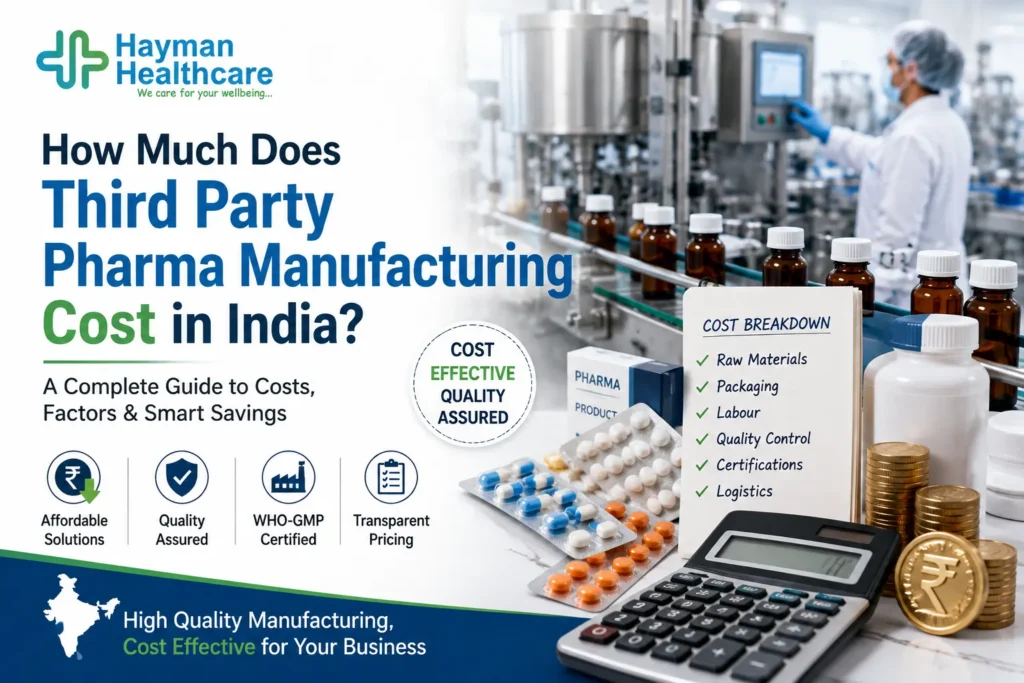
Let’s get this out of the way you don’t need to be millionaire to start your own pharma brand in India anymore. Forget crores for a giant factory; most folks just team up with a third-party manufacturer. Why buy your own baggage when you can rent the whole trip, right? This is how most PCD companies, distributors, and up-and-coming entrepreneurs actually get their medicines out there with their own brand, minus the drama of owning a plant.
Naturally, the first question everyone has is: so… how much is this really gonna set me back?
There’s no flat price tag. It swings a lot depending on what you want to make, how much, how it’s packed, and whom you choose. To give you a rough ballpark, if you want to launch 5–10 regular products, you’re looking at something around 2 to 5 lakhs. Small timers with just one or two products might even get away with less. But, and it’s a big ‘but’, it really depends on your manufacturer’s, your product type, and batch size.
What Exactly Is Third-Party Pharma Manufacturing?
Basically—it’s contract manufacturing. You pick the product mix, they whip it up, put your label on the box, and brand your “factory-made” drugs… without owning a factory. As easy as ordering food delivery. No worrying about massive capital investment, regulatory headaches, complex equipment.
It’s a sweet deal for anyone who wants to test the waters or scale up carefully—not everyone’s ready to dive into huge fixed cos ts or daily production chaos.
What’s The Actual Cost?
No two products are priced alike. If you dig around, most common tablets and capsules cost somewhere between ₹50,000 and ₹2,00,000 for a batch. Syrups and liquids are a bit cheaper (think ₹30,000 to ₹1,50,000 per batch). Injections? Pricey; figure at least ₹1 lakh. The artsy stuff—packaging, labeling, all add another ₹5,000–₹25,000.
Typical starting budget if you want a handful of products: ₹2–₹5 lakh for a decent mix. These are very general “just to give you the idea” numbers. Details will always change based on API prices, how complicated your product is, your batch size, and what kind of packaging you insist on.
Rough Price Guide:
Tablets/Capsules: ₹50,000–₹2,00,000 per batch
Syrups: ₹30,000–₹1,50,000 per batch
Injections: ₹1,00,000 or more per batch
Packaging: ₹5,000–₹25,000+
Launch budget for 5–10 products: ₹2–₹5 lakh
What Jack Up the Cost in Third-Party Manufacturing?
– Type of Medicine: Regular painkillers vs. complex injections—totally different worlds. Injections = stricter rules, sterile plants, expensive gear.
– Composition: The main ingredient decides a lot. Fancy molecules? Your wallet will feel it.
– Order Quantity: Big batches give you a lower price per unit, but you need to cough up more upfront.
– Packaging: Alu-alu is posh (and costs more) than regular blister. Go full premium, and your costs go up again.
– Branding/Artwork: Don’t forget custom designs and legalities. Sometimes, this is an afterthought`.
PCD Franchise to go upon:Hayman Healthcare
Hayman Healthcare is relatively new (started 2022), based in Panchkula, Haryana. Officially, it’s listed in company records as trading/distribution, PCD pharma franchise-type stuff. They push a product list of 143 medicines—tablets, syrups, injectables, and fancy combos like Aceclofenac + Paracetamol, Azithromycin, calcium pills, etc.
Now, here’s the catch: They offer “3rd Party Manufacturing” on their public pages, but technically their official license is for trading, not manufacturing. So they don’t own a huge manufacturing plant. Most likely, they partner with licensed factories. You get the benefits, but always double-check who is actually making your medicines, and ask for current certificates.
If you want to play it safe, get confirmation about which facility they’re using for your product, that plant’s valid license, and their quality status. It does matter especially for legal and quality reasons.
What All Can You Get via Third-Party Manufacturing?
Almost everything, if you find the right partner. Usual lineup is:
– Tablets, Capsules (including softgels),
– Syrups, Dry syrups, Suspensions,
– Injections,
– Ointments, Creams,
– Powders, Sachets,
– Nutraceuticals
But, not all manufacturers are licensed for everything.
The usual mandatory things includes:
– GST Registration
– Drug License
– Your PAN,
– Product/Brand Details,
– Manufacturing Agreement,
– Artwork/Packaging samples,
– Any specific regulatory stuff
The manufacturing contract is the real player. Make sure it’s solid about responsibilities, expected specs, and all the boring-but-critical details.
Can You Cut Down On Costs?
Absolutely. Don’t swing for 30 products on day one. Start lean—just a few star performers. Haggle on MOQs. Choose sane packaging. And always get an all-in quote so you’re not shocked by surprise charges for testing, logistics, printing, or a last-minute GST problems.
Must-Ask Questions Before You Sign Anything:
- What’s the MOQ? If it’s 3000 units and you only want 500, that’s a problem.
- Price “all inclusive” with packaging?
- Who’s the actual manufacturer? Proof?
- What certificates does their plant have—GMP? WHO?
- How long to make and deliver?
- Can you put my brand/logo/custom design?
- Will you give quality-control paperwork?
- Who sorts regulatory stuff?
- Payment terms? Advance? On delivery?
- What if I’m unhappy with a batch?
Conclusion
Third-party pharma manufacturing is pretty much the golden ticket for new players in Indian pharma. It’s way easier and way cheaper than building your own factory. If you plan smart (start with a tight product list, don’t get greedy with order sizes, focus on reliable partners vs. just the cheapest), you can get rolling with a couple of lakhs.
Hayman Healthcare looks decent for folks shopping for multiple product options but—like with every player—confirm the manufacturer details, licenses, MOQs, and get a formal quote before you hand over your cash. Documentation trumps promises, every single day.
Honestly, the lowest quote isn’t the win—reliability, transparency, steady supply, and real quality is what’ll help your pharma brand survive. Don’t cut corners, pick partners that have their act together, and read the fine print twice.